A cat tree is not a luxury. For indoor cats, it’s part of a healthy environment. Climbing, scratching, observing, and resting up high all support natural feline behavior. Whether you share your home with one cat or several, having vertical space matters.
That said, buying multiple cat trees can get expensive quickly. Many low-cost options cut corners on stability or materials, and not every home or cat fits a one-size-fits-all design. Space limitations, large cats, senior cats, or specific layouts often call for something more thoughtful.
That’s where building your own cat tree can make sense.
DIY does not mean rushed, unsafe, or improvised. When done properly, a homemade cat tree can be sturdy, long-lasting, and tailored to your cat and your space. The key is planning, using the right materials, and building with safety in mind from the start.
This guide walks you through the three core steps behind building a quality DIY cat tree. It is designed to help you understand the process, avoid common mistakes, and decide whether a DIY build is right for you.
A Quick Note On Safety And Responsibility
Building a cat tree involves tools, materials, and structural decisions that affect both human and animal safety. Always follow manufacturer instructions for tools and hardware. Use appropriate protective equipment, work carefully, and never rush structural steps.
Cat Climbing Structures provides educational guidance only. You are responsible for ensuring your build is safe, stable, and appropriate for your cat and home. If at any point you are unsure, a professional carpenter or contractor can build a plan for you.
With that foundation in place, let’s walk through the process.
Step 1: Design Your Cat Tree With Purpose
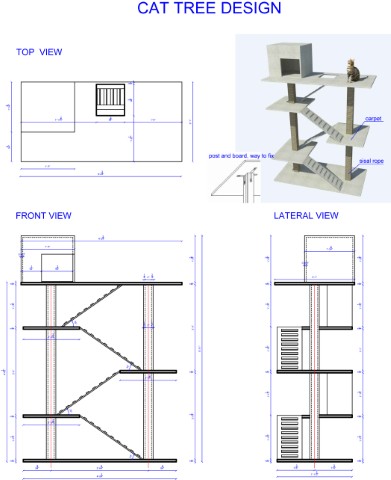
Before you buy a single piece of wood or cut anything to size, you need a clear plan. Design is not about making something fancy. It’s about making something safe, stable, and usable for your cat.
A design plan helps you:
- Visualize the final structure
- Determine materials and measurements
- Anticipate stability and load requirements
- Avoid costly mistakes mid-build
You can sketch your design on paper or work from a professionally developed plan. What matters most is that every component has a purpose and fits together logically.
Key Factors To Consider During Design
Your Available Space
Measure the area where the cat tree will live. Ceiling height, wall clearance, and floor space all matter. A tall tree needs a wider or heavier base than a shorter one. Tight spaces may require vertical designs or wall-adjacent builds.
Your Cat’s Size, Age, And Behavior
A lightweight kitten and a 20-pound adult cat place very different demands on a structure. Jump distance, platform size, and overall strength should reflect your cat’s body and habits. Climbers benefit from vertical layouts. Cats who prefer lounging may need wider, lower platforms.
Stability Requirements
Height and stability go hand in hand. The taller the structure, the more attention must be paid to base size, material thickness, and anchoring options. This is not an area to guess or improvise.
Your Skill Level
Simple builds are often the safest place to start. A clean, sturdy design executed well is always better than a complicated structure built beyond your comfort level.
Using Reliable Plans
Many free plans online are incomplete, poorly explained, or ignore weight and safety considerations. A good plan clearly outlines measurements, materials, and assembly order so nothing is left to chance.
Design is where quality begins. Everything else depends on it.
Step 2: Choose Materials That Support Strength And Safety

Once your design is clear, material selection becomes straightforward. Every material should serve a structural or functional purpose.
Common Materials Used In DIY Cat Trees
Wood For Structure
Plywood is commonly used for platforms, while solid lumber is better for vertical supports. Thickness matters. Thicker materials reduce flexing and improve long-term stability, especially for heavier cats.
Coverings And Scratching Surfaces
Carpet, upholstery fabric, or tightly wrapped sisal rope are commonly used. These provide traction and scratching outlets while covering screws and hardware. Materials should be durable and securely attached.
Fasteners And Adhesives
Wood screws provide the strongest connections. Wood glue can add strength when used correctly but should never replace proper fastening. All hardware should be appropriate for load-bearing use.
Tools You May Need
Depending on your plan, tools may include:
- Drill and drill bits
- Wood screws
- Measuring tape and level
- Saw suitable for your materials
- Sandpaper or sander
- Staple gun for coverings
Always follow your plan’s material and tool list closely. Substitutions should only be made when you understand how they affect strength and stability.
Creativity is welcome. Cutting corners is not.
Step 3: Assemble With Stability As The Priority
Assembly is where your planning pays off. Take your time and follow the build order exactly as outlined in your design.
Prepare All Materials First
Cut all wood pieces to size before assembly. Sand edges to remove splinters and rough areas. Dry-fit components if possible to confirm alignment before fastening anything permanently.
Build A Strong Base
The base is the foundation of the entire structure. It should be wider than the tallest point of the tree and heavy enough to resist tipping. Taller builds require proportionally larger or reinforced bases.
Layered plywood bases or thick solid wood bases are common solutions. Never underestimate this step.
Cover The Base Before Uprights
Covering the base with carpet or fabric before attaching vertical supports makes installation cleaner and more secure. Wrap edges neatly and staple firmly underneath so no loose edges remain.
Install Vertical Supports Securely
Vertical posts carry most of the load. They must be attached using strong fasteners driven into solid material. Posts should sit flush and square. Wrapping posts with sisal rope or carpet adds function but should never interfere with the structural connection.
Attach Platforms And Perches
Platforms should be level, securely fastened, and appropriately spaced for your cat’s jumping ability. Cover platforms after attachment to hide hardware and improve traction.
Inspect And Test
Before allowing your cat to use the structure, test it yourself. Apply pressure from different angles. Look for wobble, flexing, or loose components. Tighten or reinforce as needed.
Stability is not optional. It is the standard.
What Comes Next
Now you understand the process behind building a DIY cat tree. The next step is deciding how far you want to take it.
Some readers are comfortable designing and building on their own. Others prefer clear, step-by-step plans with exact measurements, material lists, and safety considerations already worked out.
As Cat Climbing Structures continues to expand its DIY resources, you’ll find:
- Beginner-friendly build plans
- Designs for different spaces and cat sizes
- Safety-focused guides and checklists
- Maintenance and inspection resources
If you’re ready to move from concept to construction, professionally developed DIY cat tree plans can save time and reduce uncertainty.
If you’re still learning, explore our educational guides to build confidence before you begin.
Either way, building vertical space for your cat is an investment in their comfort, health, and happiness. When done thoughtfully, DIY can be both rewarding and safe.
If you have questions or want to share your experience, feel free to join the conversation in the comments.
I love it! Plans for a homemade cat tree! That is so cool.
Your article inspires me to test my remaining carpentry skills. I have a cat who would really enjoy a cat tree, and they are so expensive so this will hopefully save me a lot of money. Building one myself makes more sense.
My last cat would have loved a really tall tree, as he was quite the climber. However, my present cat is an older cat that I “rescued” from a shelter, and he is not much into jumping.
I’m guessing I could build him something that isn’t too high, with one of those ramps for him to go up. Would that be easiest for him?
You’ve provided us with some great information that is helpful to our kitty companions.
Hey Fran!
Thanks for sharing about your kitties with us. They sound absolutely precious!
Yes, you can add ramps to the cat tree. Some cats will still want to be up high so you can try using this cat tree plan.
It has ramps going all the way to the top so that even older cats can reach the heights they desire to be. If you want, you can also check out our list of the best cat trees for older cats because it might just be easier for you to buy one.
Hope this helps 🙂
Marlinda
This is so true and helpful. I am a cat and dog owner and my pets actually like one another.
My cat gets on top of everything in my home. Cats keep to themselves and don’t listen to their owner.
My cat never listens to me, I mean she’s a cat. They naturally just don’t listen.
I should definitely make her a cat tree so she can stop getting on top of everything.
Thank you so much for this article and all the best.
Aabidah
Hey Aabidah! You are so right. Cats don’t listen but they can get along with dogs.
I think its a lot to do with the mindset of the owner but also how the two are introduced to each other. The breed of the dog has something to do with it too as some have stronger prey drive than others.
That being said, I have Pitts and Pitt mixes which have a very strong prey drive and are afraid of kittens but I’ve helped them to be comfortable with cats so they cuddle together and everything.
Having somewhere to be off the ground is very important for cats. Whether it is made or bought, it must be sturdy and provide your cat with the kind of escape it likes.
Thanks for sharing and commenting.
Take care of your beautiful animals 🙂
Marlinda
Having had several cats through my lifetime I know the problems with cats deciding to climb or to use good furniture as scratching posts.
You have outlined how to go about designing and manufacturing a cat climbing tower and also how to incorporate scratching posts in the structure.
I would have no problem recommending your site to friends and relatives for them to either self-design and build or to make use of your premade plans.
Hey Derek!
Thanks for sharing your experience with us. We really value and appreciate this comment.
Yes, cats can cause quite some damage to furniture and other structures in your home if they aren’t given the proper outlets to scratch. There’s no denying that good quality cat trees are expensive BUT with a little bit of work, you can have custom pieces in your home for a fraction of the cost!
It’s really great for bonding and improving skills too.
Thanks for sharing and really appreciate the referrals!
Marlinda
This was a very useful article on how to build your own cat climbing tree. I am interested because I have 2 cats and they would love to have something like this to play on.
Right now they spend time outside, but in the heat of the Summer (I am in Dubai) it is really too hot for them out there.
Of course, they still like to play and get a little crazy, so I am thinking that a cat tree would provide some entertainment for them while keeping the furniture intact. I looked at the plan offer that you have as well, and that looks nice.
I would like to have known more details such as materials needed (amounts) and the approximate cost (based on common prices I guess)…
The scrap piece idea as shown in the video makes sense and that cuts the cost down quite a bit. Essentially you use what you have and just piece it together I guess?
That is likely what I will go with, and design the tree based on what I have on hand. Thanks for the article, you have provided me with a new project for the weekend!
Hey Dave,
Thanks for your comment and question. I know your cats will enjoy their new cat tree.
The cost of the cat tree really depends on the type of wood you use and the size of it. Since the cat tree plan you are referring to is quite large, it will cost more than one like the one shown in the video.
You can expect to pay about $150ish for the one in the plans. That is compared to a tree that size and quality costing $300+ you can see it is a real saving.
A smaller one, like the one in the video might cost about $50 or so whereas if you bought one it will still cost you upwards of $100.
Your location also plays a roll in cost as well. Different places will have different prices.
Hope this helps and I will add more information into the description.
Marlinda
How awesome is this!
An acquaintance of mine gathers street cats at her backyard and shelters them. She really loves cats and would love to read this article.
I will share this asap. This is a great project as well to develop new skills hence, practice makes perfect. Personally, trying new things is how I have come to developed my skills.
Hey Linda! Thanks and I’m glad you enjoyed this article. If your friend has any questions or comments please let her know to feel free to leave them under any of our posts.
Take care 🙂
Marlinda
Nice article: I also have a good experience about it: I figured that it must cost a lot of money to be able to make a cat tree because they sold for a lot of money everywhere I looked.
I was surprised when I found a section in the book that showed me ways that I could save money on the materials that I needed.
Hey Fabio!
Thanks for your comment and sharing some of your thoughts with us. Yes, it can be easy to assume that something is expensive by looking at their prices in stores.
But I like to always remember that anything in a store has a markup because they have to pay for bills to run the store, etc and of course turn a profit at the end of the day.
Building a tree can get expensive as well, it just depends on the materials that you use and what your end goal is. But regardless, it will always be cheaper to build your own cat tree than to buy one made the same way.
Take care 🙂
Marlinda
Hello Marlinda,
I appreciate the detailed instruction on building a cat tree. I have tackled this project before and had mixed results.
After reading your post, I’ve determined that I have made two mistakes in the past. The first is not having the proper tools. The gentlemen in the video makes everything look so easy when you have the proper tools. And although I don’t plan of going out and buying a table saw, I might borrow one for my next project.
Also, I have not built a cat tree with plans before, imagine that. I just kind of went off examples I saw in a pet store.
One of the projects I completed was a little off balance and I ended up throwing it out. Anyway, the video was very helpful and I look forward to picking one of your plans to build.
Glenn
Hey Glenn!
Thanks for your comment and sharing your experience with us. It is so important to have a PROPER plan before you take on ANY DIY project.
Let me know how it goes and if you have any questions, comments or other feedback please feel free to leave them under this post.
Thanks and all the best!
Marlinda
Hey
That is such an interesting article. Sure, there are a lot of different kinds of ready-made cat furnitures but this is completely out of the box. It puts one’s mind to good use too.
There will be a lot of mistakes initially but in the end, it would obviously be worth it. I’m excited to try it out myself.
I’ll share it with my friends too who are absolutely mad about cats.
Thanks for sharing
Hey Shashwat!
Thanks for your comment and sharing our site with your cat parent friends. We really appreciate it and can’t wait to see your finished product too! 🙂
Take care and have a good weekend,
Marlinda
What a great idea! I have never seen anything like this.
However, it’s been a long time since I owned cats so that probably explains it. The big thing back when I had a cat was making sure you had a scratching post.
I finally got one after the cat started digging his nails into the sofa every day.
Cats are very territorial and often will want to sit in your favorite recliner. For this reason alone, a cat tree would probably be an excellent idea.
In time, a cat would probably find the top of the cat tree the best view in the house and make that his new favorite spot.
I’ll have to send my son a link to this post as they have two cats and this might be perfect for them.
Hey Ray,
Thanks for your comment and sharing your experience with us. Yes, cats will sink their claws into furniture and even appliances if they can’t find something they like to scratch on.
Cat trees are so readily accessible and every cat owner should have at least one, preferably multiples of the Best Quality Cat Trees of 2019. I agree that when you make a space for your cat(s) to claim, they will feel right at home and leave your spaces alone since they feel like they own their own.
Thanks for sharing and appreciate the referral! Please let your son know that he can leave any questions, comments or other feedback under any post on this site.
Take care,
Marlinda
Great article it was very educational. I like the pieces where I learn something. I was wondering what would be an estimated cost of the materials?
I wish my cat weren’t so stubborn when it comes to cat furniture. I got her a scratch post with a toy attached, and she ignores it.
She climbs over the scratch pole and scratches the window seal behind it. Good price though on the plans.
Thank you for the article!
Cheers, and take care of yourself!
Thanks and I’m glad you found value in this information. The price really depends on the type of tree you are building, the board you are using and your location.
I’d say between $50 and $150 depending on the size and quality you are going for.
Yes, some cats like the sound when their paws/claws hit the glass. I find cats are very easily entertained and tend not to like expensive toys, lol.
A lot of times trees that come with toys are complete crap, to be honest. Try getting her one from Cat Tree Kings. You also have to pay attention to what and where she likes to be. She just might not like being on the ground and prefer being at the window instead.
She also might prefer to be hidden away instead of out in the open. I have a cat who finds the best hiding places when it’s her nap time. She makes sure you won’t find her and if you do she finds an even better hiding spot, lol.
Hope this helps and thanks for your question and feedback 🙂
Marlinda